
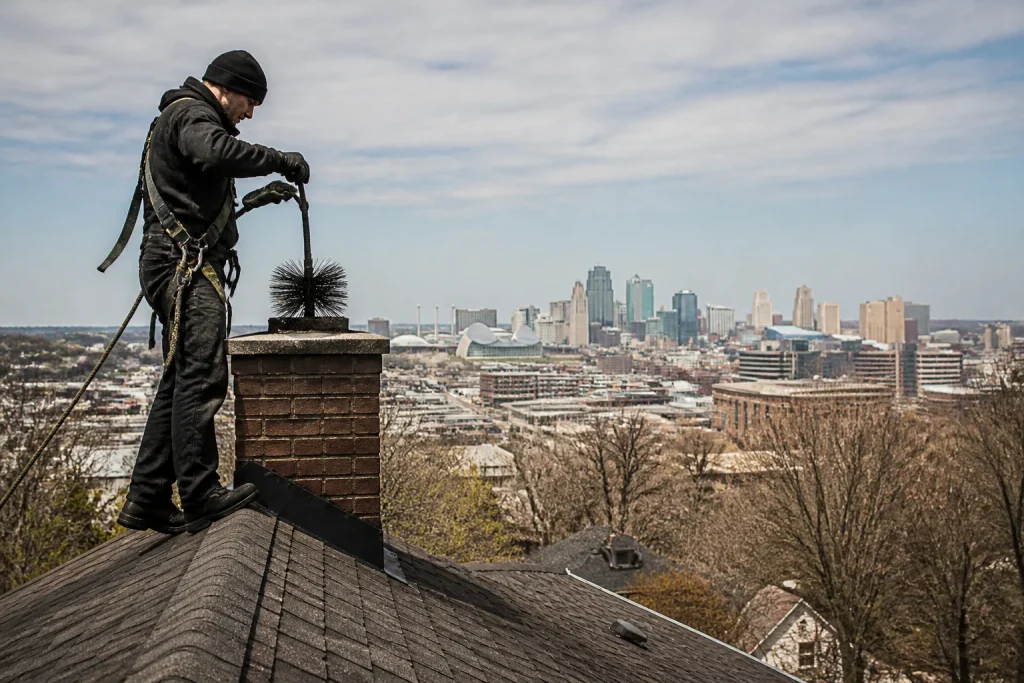
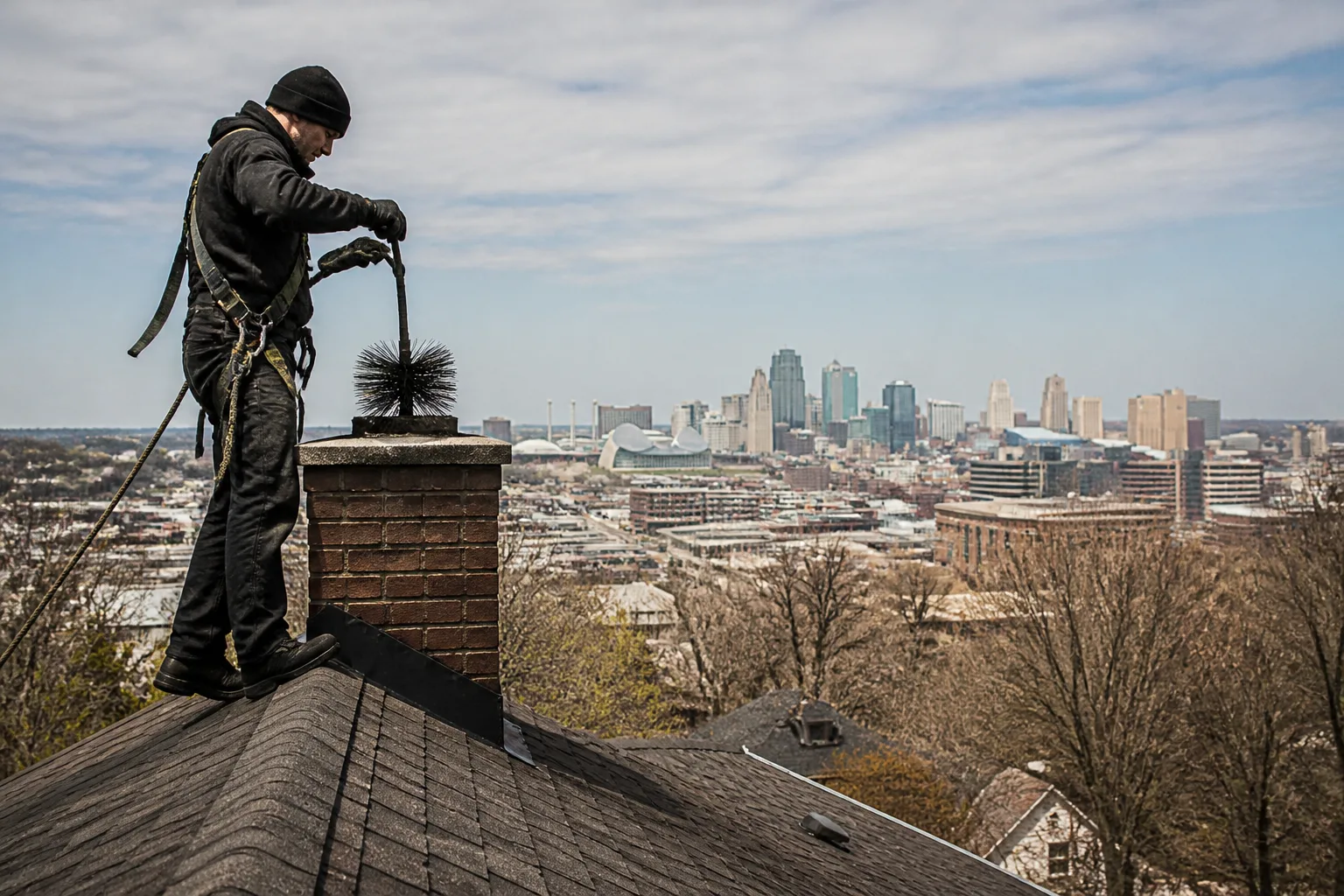
Emergency Chimney Sweep Near Me: What Kansas City Homeowners Should Do First
If you’re searching “emergency chimney sweep near me” while smoke is backing into the room, the sweep is not the first call. The first call is 911. A chimney fire can climb past 2,000°F and reach the wood framing around the flue in under four minutes, and the actions in the first minute either contain the damage or feed it. This post walks Kansas City homeowners through that sequence in order: what to do, what to watch for, what to document, and what actually has to happen before the fireplace is used again. If you’d rather have a pro handle the inspection once the danger has passed, call (866) 480-2930. We answer 24/7.
What should you do in the first 60 seconds of a chimney fire in Kansas City?
Close the damper, get everyone out, and call 911. In that order, and fast. The damper starves the fire of the air it needs to grow, evacuating protects the people in the house, and the fire department decides whether the fire has spread beyond the flue. Do not try to fight it with water, do not climb onto the roof, and do not wait to see whether it “settles down.”
A chimney fire can sound like a freight train or a low roar, and that noise is your cue to move. The steps below apply whether you burn wood in a masonry fireplace or run a gas insert in a Kansas City home.
- Close the damper. Cutting off the air supply limits how hot the fire can burn.
- Evacuate the house. Get people and pets outside, and account for everyone.
- Call 911. Report a possible chimney fire and give your address.
- Do not use the fireplace again. Even if it looks fine, it isn’t until it’s been inspected.
- Note the time and what was happening. This helps both the fire department and the inspector.
The part homeowners skip is step four. A chimney fire that seems to have burned itself out can leave cracked flue tile or a warped liner that lets heat and carbon monoxide into the house later. That’s why a Level 2 inspection comes next, not a sweep.
How do you tell a chimney fire from a heavy creosote smoke event?
Chimney fires are loud, creosote smoke events usually aren’t. A real chimney fire tends to announce itself with a roar, popping sounds, and flames or dense smoke from the top of the chimney. A heavy smoke event from a creosote-heavy flue is quieter, but it still means dangerous conditions, and it can lead to a fire the next time you light up.
Here’s how the cues break down:
- Sound: A freight-train roar or repeated popping suggests a fire. Silence or a quiet whoosh points more toward a smoke backup.
- Smell: A sharp, acrid, tar-like odor can mean creosote is igniting. A smoky, woody smell alone is more typical of a draft problem.
- Sight: Flames or sparks from the chimney top, or thick black smoke, point to fire. Smoke curling back into the room points to a blocked or undersized flue.
- Heat: A chimney that stays hot to the touch long after the fire is out, or a hot smell in the room, is a warning sign.
If you’re unsure which you’re having, treat it as a fire. Close the damper, evacuate, and call 911. In our experience, the homeowners who end up with the least damage are the ones who err on the side of caution rather than waiting to see smoke clear.
What should Kansas City homeowners document before the sweep arrives?
Photos, the fuel, the timeline, and anything odd you noticed. A post-incident inspection goes further when the inspector knows what happened and when. Your records tell them where to look.
- Photos. The firebox, the damper, the hearth, the top of the chimney if you can safely see it, and any smoke staining or discoloration on walls or the mantel.
- What was burning. Seasoned hardwood, unseasoned wood, a manufactured log, paper, or a gas appliance. Each behaves differently and each leaves different residue.
- How long. Ignition time, the moment you noticed the problem, and how long the event lasted.
- Sounds and odors. Roaring, popping, a tar-like smell, or a hot smell in the room. Note it while it’s fresh.
- Any prior warning signs. Smoke that had backed up before, a draft that felt weak, or soot that kept building.
Bring these to the inspection. We use professional-grade materials on every repair, and a documented event tells us whether the right product for the job is a DuraFlex stainless liner, a HeatShield resurfacing, or a simpler fix. Without documentation, an inspector is guessing. With it, the repair plan is specific.
Why is an “emergency sweep” after a chimney fire the wrong service?
Because a sweep cleans, and a fire event calls for an inspection and possibly a repair. Google the phrase and you’ll find cleaning companies ready to brush the flue and move on, but brushing won’t reveal a cracked flue tile or a warped liner. What a fire event actually requires is a Level 2 inspection with a camera, which looks inside the flue for damage cleaning never touches.
The companies that show up fast are the ones to watch closely. Red flags in a crisis:
- No camera inspection. If they don’t look inside the flue, they can’t tell you what’s damaged.
- Liner replacement pushed before any damage is documented. A cracked flue isn’t the same as a failed one, and HeatShield resurfacing can often restore a damaged flue instead of replacing it.
- Generic hardware-store caps or venting. Purpose-built parts from Famco or Olympia Chimney are the standard on a proper repair.
- A hard sell during a stressful moment. A reputable company documents first, then explains the options.
Any full-service company that offers chimney sweep work alongside structural repair and can show you the camera images before recommending anything. If they can’t, slow down and get a second look.
When should a Kansas City homeowner call a pro, and what happens on the call?
Call a pro after any fire event, any heavy smoke backup, or any time the masonry or liner looks or feels wrong. Call 911 first if there’s active fire, smoke pouring into the room, or any sign of collapse. Once the danger has passed, a chimney and venting specialist should take over.
When you call, expect a few questions. What happened, when, what you were burning, and what you’ve noticed since. We use that to book the right inspection and to tell you whether the fireplace stays off until then. Our technicians have up to 12 years of experience, and the inspection includes a camera look and a photo report, so you see the evidence rather than taking our word for it.
If the liner is damaged, the fix may be a stainless-steel reline with DuraFlex, or a HeatShield resurfacing that restores the flue instead of replacing it. If the damage is mild and the flue is sound, we say so and tell you when the work can safely wait. A sweep and inspection are booked, not rushed, and the urgent thing after a fire is the inspection, not the cleaning.
Related services in Kansas City: after a fire event, it’s also worth checking the dryer vent cleaning and the rest of the venting system. Lint buildup and a compromised flue share the same fire-risk category, and one provider can handle both.
The Bottom Line
The first 60 seconds of a chimney fire are about safety, not service. Close the damper, get out, call 911, and keep the fireplace off until a Level 2 inspection clears it. After that, a documented inspection tells you whether you need a HeatShield resurfacing, a DuraFlex reline, or just a cleaning and a new cap.
If you’re in Kansas City and need help, Kansas City Chimney Cleaning offers free estimates. Call (866) 480-2930. We answer 24/7. Fast dispatch from 7am to 7pm, Sunday through Friday. We resurface, reline, and repair, not just sweep, and nothing gets recommended without camera evidence you can see for yourself.
Frequently Asked Questions
Not always. A camera inspection is the only way to know. If the flue tile is cracked or the liner is warped, a DuraFlex stainless reline or a HeatShield resurfacing restores safety; if the damage is mild, it can wait. Call (866) 480-2930 for an exact quote. Estimates are free.
Most wood-burning fireplaces should be swept roughly once a year or when creosote builds to about an eighth of an inch. Heavy use or unseasoned wood means more frequent sweeps. A free estimate from a Kansas City chimney cleaning team tells you where you stand.
No. A fire event can leave cracks or warping that let heat and carbon monoxide into the house, so keep it off until a Level 2 inspection clears it. Call (866) 480-2930 to book the inspection.
Damage you can’t see can worsen and lead to a second fire, a carbon monoxide risk, or a liner failure. The inspection is the cheapest step. Call (866) 480-2930 for a free quote and to schedule.
We answer 24/7. A call outside dispatch hours is booked into the next opening, Sunday through Friday, 7am to 7pm. We’re closed Saturday, so a weekend failure gets booked for Sunday. What if Saturday is your only option? Call (866) 480-2930 and we’ll get you on the schedule.
Written by the team at Kansas City Chimney Cleaning.
Need Chimney Cleaning Help?
Call Kansas City Chimney Cleaning - licensed & insured, with free written estimates in Kansas City.
(866) 480-2930